
On 7 August, in Al-Safa Palace in Mecca, Prime Minister Shehbaz Sharif signed a document that changes what Pakistan is obliged to do if a war starts somewhere else. Alongside Saudi Crown Prince Mohammed bin Salman and Turkish President Recep Tayyip Erdogan, he committed Pakistan to a principle that until now it had extended to only one country: that an armed attack on a partner is an attack on Pakistan itself.
The Mecca Joint Defence Agreement has been described as a NATO-style pact, and in one narrow respect that comparison holds. But the differences matter as much as the similarities, and for Pakistani readers the important questions are practical ones. What has Pakistan actually promised? What has it already committed on the ground? And what does the agreement carefully avoid saying?
What was actually signed
The core of the agreement is a single principle: any armed attack against any one of the three states is to be regarded as an attack against them all. The stated purpose is to strengthen collective deterrence against aggression and to broaden defence cooperation between the three countries.
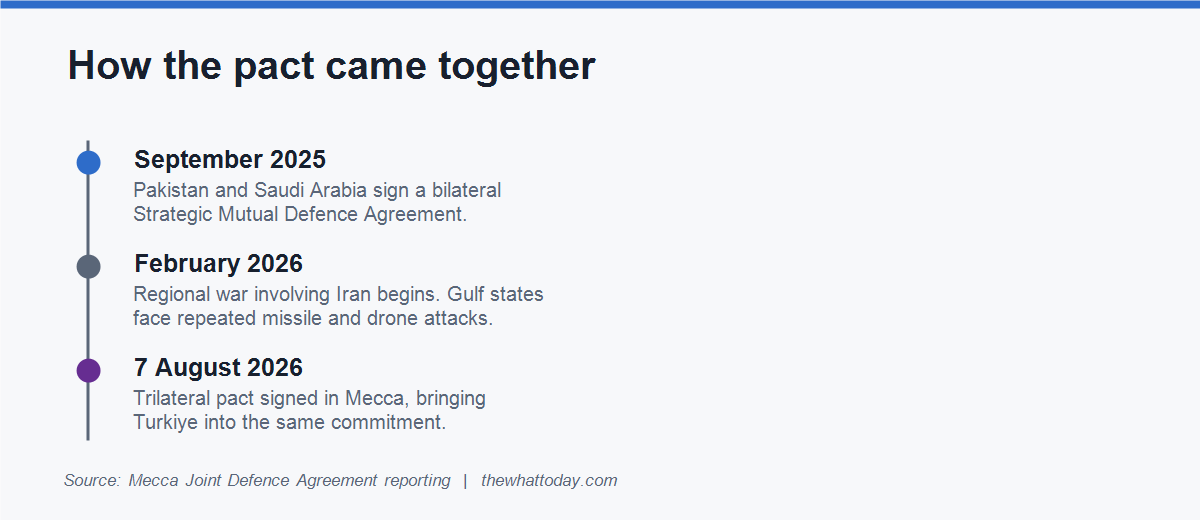
It did not appear out of nowhere. The pact extends a bilateral arrangement — the Strategic Mutual Defence Agreement that Pakistan and Saudi Arabia concluded in September 2025 — to bring Turkiye inside the same commitment. Reporting on the deal indicates it followed close to a year of negotiation.
On paper, the three signatories bring complementary weight. Turkiye fields NATO’s second-largest military. Saudi Arabia is the world’s largest oil exporter. Pakistan is the only Muslim-majority state with nuclear weapons — a fact that has shaped how the agreement has been read abroad, whatever the text itself says.
Why Mecca, and why now
The choice of venue was not incidental. Signing a security pact in Islam’s holiest city frames it as something more than a transaction between defence ministries, and that framing is part of the message.
The timing is more straightforward. The agreement was concluded against the backdrop of the regional war involving Iran that began in February 2026, during which Saudi Arabia and other Gulf states came under repeated missile and drone attack. Saudi Arabia has faced threats from more than one direction, and strikes have disrupted energy exports. Read in that light, the pact is less an ambition than a response.
What Pakistan has already committed
This is the part most likely to be overlooked, and it is the most consequential for Pakistan.
Pakistani forces were in Saudi Arabia before the ink dried. Reporting on the agreement indicates Pakistan had already deployed several thousand troops, together with fighter aircraft, drones and an air-defence system. The agreement formalises a relationship that has existed for decades, during which Pakistan supplied training and technical assistance to Saudi forces.
In other words, the signing ceremony did not create Pakistan’s exposure. It documented it. For anyone assessing what the country has taken on, the deployments already in place are the more useful measure than the language of the treaty.
How it is meant to work in practice
Turkish Foreign Minister Hakan Fidan has said the pact will operate along lines familiar from NATO: ministerial committees, political and military committees, and a permanent secretariat based in Saudi Arabia.
That institutional machinery is what separates a standing alliance from a statement of intent. It also means the agreement will generate ongoing obligations — meetings, planning, joint structures — rather than sitting dormant until a crisis arrives.
What the agreement does not say
Turkish officials have been explicit on several points. The pact is described as purely defensive and not directed at any particular country. It remains open to other regional states, and it does not supersede existing bilateral arrangements.
Those caveats do real work. A collective-defence clause that names no adversary preserves flexibility for all three signatories, and leaves considerable room for interpretation about when the commitment is actually triggered. Egypt has been discussed as a possible fourth member, though that had not materialised at the time of reporting.
What has not been published, at least so far, is the detail that would answer the harder questions: what counts as an armed attack, what each state is required to contribute, and who decides.
How the region responded
The reaction has been more mixed than the framing around the signing suggested.
Iran’s response was notably measured. Foreign Minister Abbas Araghchi welcomed the agreement and used it to call for greater unity among Muslim-majority countries, although the Iranian parliamentarian Ebrahim Rezaei publicly questioned how effective it would prove. The Organisation of Islamic Cooperation and Bahrain both welcomed the pact as a step towards regional stability.
India was more guarded, saying it would assess the implications for regional stability and for its own national security. The United States had not issued a formal response at the time of reporting.
What to watch next
Three things will indicate whether this becomes a working alliance or a symbolic one.
The first is the secretariat. If the permanent body in Saudi Arabia is staffed and begins producing joint planning, the pact is real in an institutional sense. The second is membership: whether Egypt or another state joins would show whether the arrangement is genuinely open or effectively closed. The third, and the most important for Pakistan, is whether the deployments already made expand, and under what terms parliament is told about them.
For a country that has spent much of the past decade trying to keep its distance from other people’s wars, a mutual-defence commitment in a region at war is a significant shift — and the details that would tell us how significant have not been made public yet.
Sources: Mecca Joint Defence Agreement; Al Jazeera; Atlantic Council.

I was recommended this website by my cousin I am not sure whether this post is written by him as nobody else know such detailed about my difficulty You are wonderful Thanks