Key takeaways
Francis Halzen won the 2026 Nobel Prize in Physics on October 6 for his decisive contributions to the IceCube Neutrino Observatory and the discovery of high-energy neutrinos from deep space. The Belgian-American physicist receives 12 million Swedish crowns.
Decades under the ice
The prize rewards a scientific gamble that took decades to pay off. Halzen first proposed capturing neutrinos — the near-massless particles sometimes called “ghost particles” because they stream through almost everything untouched — using detectors buried in the ice of the South Pole. He presented the vision in 1988, and after years of sensor testing in the frozen depths, the full IceCube Neutrino Observatory was completed in 2011.
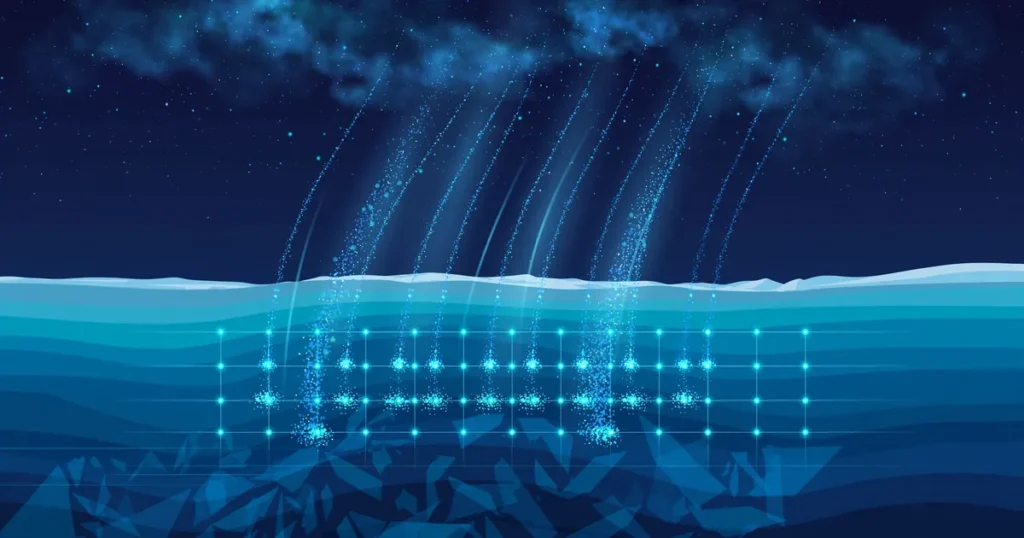
IceCube is built around a cubic kilometre of Antarctic ice laced with light sensors. When a rare high-energy neutrino collides with an atom in the ice, the flash it produces is picked up by the sensor grid, letting scientists work out where in the universe the particle came from. Because cosmic neutrinos are so scarce, that enormous volume of ice is what makes enough detections possible.
Shortly after the observatory came online, its researchers detected the first high-energy neutrinos — and later confirmed that some of them originate far beyond our solar system, the discovery that forms the core of the Nobel citation.
Why it matters
Neutrinos are messengers from the most violent places in the cosmos. The universe contains natural particle accelerators that hurl particles outward with energies up to a million times greater than anything laboratories on Earth can produce. Because neutrinos travel in straight lines without bending or losing energy, catching them tells astronomers about the extreme environments that launched them.
IceCube effectively opened a new channel for observing the universe — not with light or gravitational waves, but with particles that carry information from regions telescopes cannot see into. The observatory continues to run, and researchers expect it to keep turning up phenomena no one has observed before.
What’s next
The Physics prize is the second of this year’s Nobels to be announced, following Monday’s Medicine prize for the three scientists behind optogenetics, the technique that uses light to probe how the brain works. Chemistry is announced on Wednesday, Literature on Thursday, the Peace Prize on Friday, and the economics prize next Monday.
Halzen will receive his medal from Sweden’s King Carl XVI Gustaf at the Nobel ceremony in Stockholm on December 10, the anniversary of Alfred Nobel’s death, followed by the traditional banquet at Stockholm City Hall.