
Key takeaways
Henri Kagan and Kenso Soai won the 2026 Nobel Prize in Chemistry on October 7 for discoveries that reveal how chemical reactions can favour one mirror-image molecule over another. Their work cracked a century-old puzzle in asymmetric synthesis.
French chemist Henri B. Kagan and Japanese chemist Kenso Soai have won the 2026 Nobel Prize in Chemistry, the Royal Swedish Academy of Sciences announced in Stockholm on Wednesday. The academy honoured the pair “for the discovery of non-linear effects and autocatalysis in asymmetric organic synthesis.” The two scientists share the prize of 12 million Swedish kronor, worth about $1.2 million.
A solution to a century-old puzzle
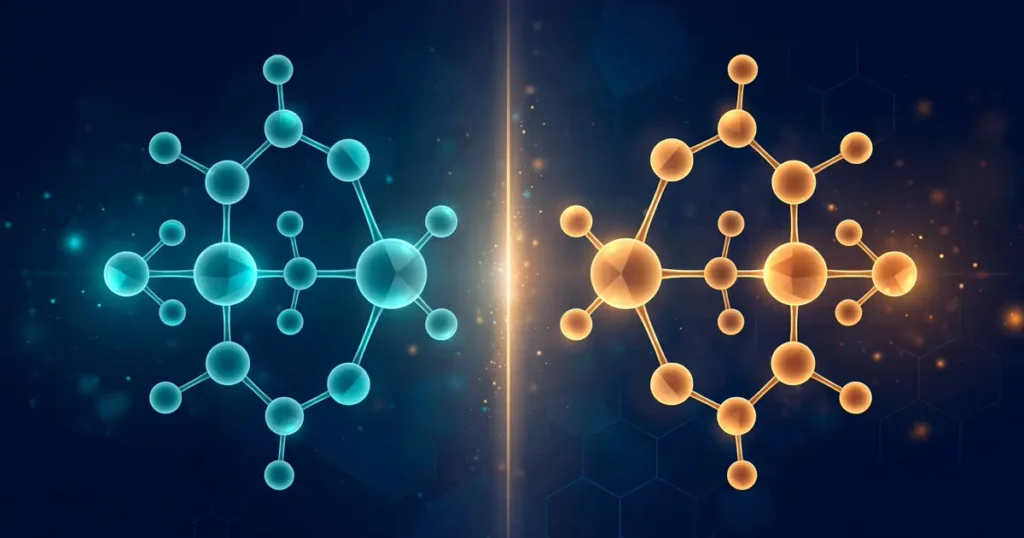
Many molecules come in two forms that are exact mirror images of each other, like a pair of hands — chemists call these “chiral” molecules. Living organisms overwhelmingly use only one of the two forms, and how that one-sidedness could arise on its own was long one of chemistry’s deepest puzzles.
Heiner Linke, chair of the Nobel Committee for Chemistry, said Kagan and Soai had “provided a solution to a chemical mystery that is over a century old: how homochirality can emerge spontaneously.” He called the chemical reactions they developed “spectacular.”
Kagan discovered a new way of steering chemical reactions so they produce a far greater excess of one mirror image than chemists had thought possible. His method has become a core tool for chemists designing reactions used to manufacture pharmaceuticals, flavours, scents, and new materials, according to the Nobel committee.
Soai went a step further. He designed the first chemical reaction in which only one of the two possible mirror images was formed at all. Until his breakthrough, the committee said, no one except life itself had ever achieved that feat. His experiment — known as the Soai reaction — is described by the committee as one of the most remarkable chemical experiments ever conducted.
Why it matters
Which mirror image a molecule takes is far more than a curiosity. Two versions of the same compound can behave very differently inside the human body — one may be an effective medicine while its mirror image is inactive or even harmful. The sedative thalidomide, whose use in the 1960s caused severe birth defects, was one of the tragedies blamed on this asymmetry. Getting reactions to make only the desired form has therefore become one of the most important skills in modern drug design, and Kagan’s and Soai’s discoveries gave chemists the tools to do it.
What’s next
The Chemistry prize is the third of this year’s Nobels to be announced. Monday’s Medicine prize went to the three scientists behind optogenetics, the technique that uses light to probe the brain; Tuesday’s Physics prize honoured Francis Halzen’s work on the IceCube Neutrino Observatory. The Literature prize is announced on Thursday, the Peace Prize on Friday, and the economics prize next Monday.
Kagan, affiliated with Université Paris-Sud in Orsay, France, and Soai, of the Tokyo University of Science in Japan, will receive their medals from Sweden’s King Carl XVI Gustaf at the Nobel ceremony in Stockholm on December 10, followed by the traditional banquet at Stockholm City Hall.
