Japan’s MMX Blasts Off to Fetch First Mars Moon Samples
Key takeaways: Japan’s MMX probe is on its way to Mars’s moon Phobos, launched by H3 rocket, to collect at least 10 grams of dust and return it to Earth in 2031.
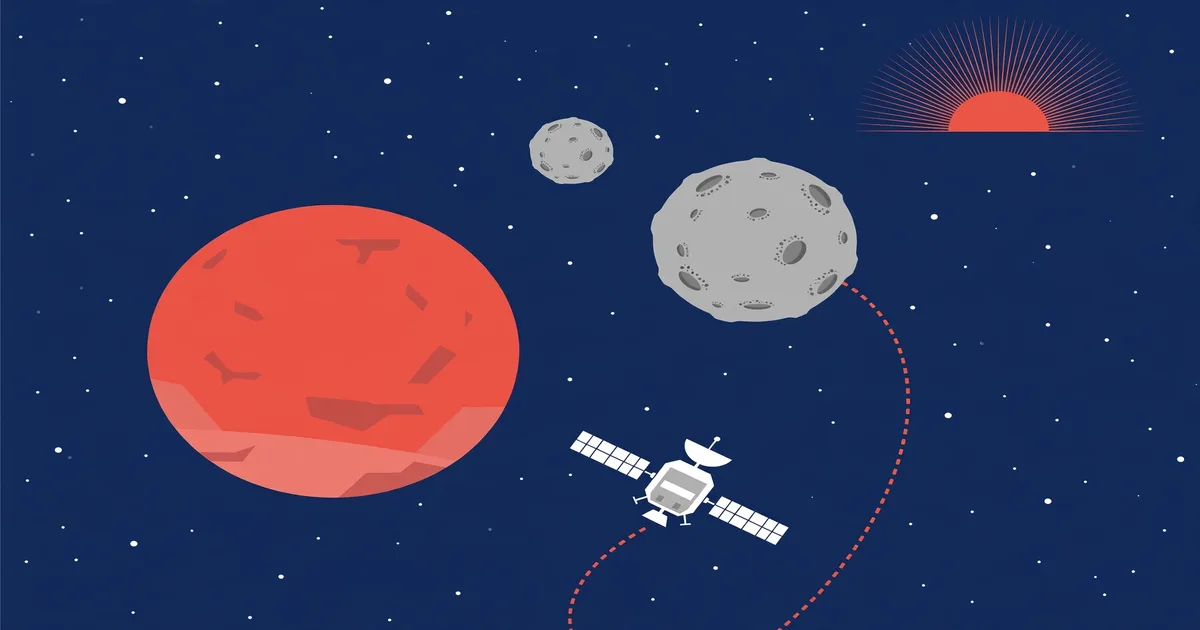
Japan’s flagship H3 rocket lifted off from the Tanegashima Space Center in the early hours of Tuesday, carrying the Martian Moons eXploration (MMX) probe — the first mission designed to bring samples home from one of Mars’s moons. About 71 minutes after launch, the Japan Aerospace Exploration Agency (JAXA) confirmed the spacecraft had separated from the rocket and was on its planned trajectory.
The uncrewed probe is bound for Phobos, the larger and closer of Mars’s two moons. It is expected to reach the vicinity of Mars in August 2027, about a year after launch, and will then spend three years studying both Phobos and Deimos. The mission’s centrepiece is a planned landing on Phobos to collect at least 10 grams of material, including samples dug from at least two centimetres below the surface.
The roughly 4,200-kilogram spacecraft carries three modules and four landing legs built for Phobos’s faint gravity — about one two-thousandth of Earth’s. Among its instruments is a miniaturised laser spectrometer built by Germany’s Fraunhofer Institute, and a small rover named Idefix, built by the French and German space agencies, which will observe the moon’s surface. NASA is contributing science instruments and ten participating scientists, while the European Space Agency is providing deep-space communications support. Japanese media put the mission’s cost at more than 55 billion yen.
The stakes are scientific: nobody knows how Mars got its moons. One theory holds that Phobos and Deimos are asteroids captured by Martian gravity; another says they formed from debris flung into orbit by a massive ancient impact on Mars. MMX’s observations and returned samples are expected to settle the question — and shed light on how water and organic materials were distributed across the early solar system, and ultimately how habitable worlds like Earth came to be. JAXA also wants to prove out the technology for using Phobos as a “natural space station,” a staging point for a future crewed round trip to Mars.
The mission builds on JAXA’s record in sample-return science: its Hayabusa2 spacecraft famously returned grains from the asteroid Ryugu in 2020. MMX goes a step further — no mission has ever brought material home from the Mars system before. “The Martian moon Phobos remains an unexplored frontier for humankind,” said MMX project manager Kawakatsu Yasuhiro.
If all goes to plan, MMX will seal its samples in a return capsule expected to re-enter Earth’s atmosphere and touch down in Australia in 2031, from where the material will be taken to Japan for cataloguing and distribution to researchers worldwide. Until then, it is a long wait — but for planetary science, a ten-gram pinch of Phobos could rewrite what we know about the birth of the solar system.
In the near term, mission controllers will monitor the probe’s year-long cruise to Mars. Its arrival in August 2027 opens the close-up study phase, with the landing and sample collection scheduled around 2030. With four space agencies invested, MMX is also a test of the kind of international collaboration that crewed deep-space missions will demand.
Sources