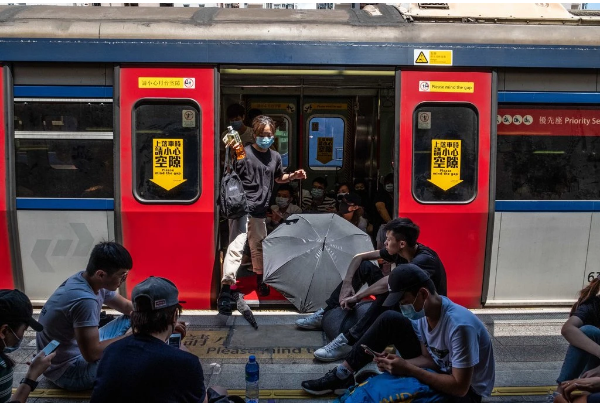
France has endured its most turbulent day of protests in years. On Saturday, October 17, more than half a million people joined over a hundred demonstrations across the country against the rising cost of living and cuts to public services. By nightfall, marches that had begun peacefully had given way to looting, arson and running battles with police in Paris, Marseille, Lyon, Bordeaux and other cities — and the 143-year-old town hall of Limoges was burning.
Prime Minister Sébastien Lecornu said more than 1,200 people were arrested by late Saturday and 150 police officers were injured. Interior Minister Laurent Nuñez put the nationwide turnout at 550,000, including 110,000 in Paris, while organisers claimed up to 800,000.
KEY TAKEAWAYS: On October 17, nationwide cost-of-living protests across France turned violent as masked groups torched cars, looted shops and set the historic Limoges town hall ablaze. Prime Minister Sébastien Lecornu said more than 1,200 people were arrested and 150 police officers injured — the country’s worst unrest in years, unfolding six months before a presidential election.
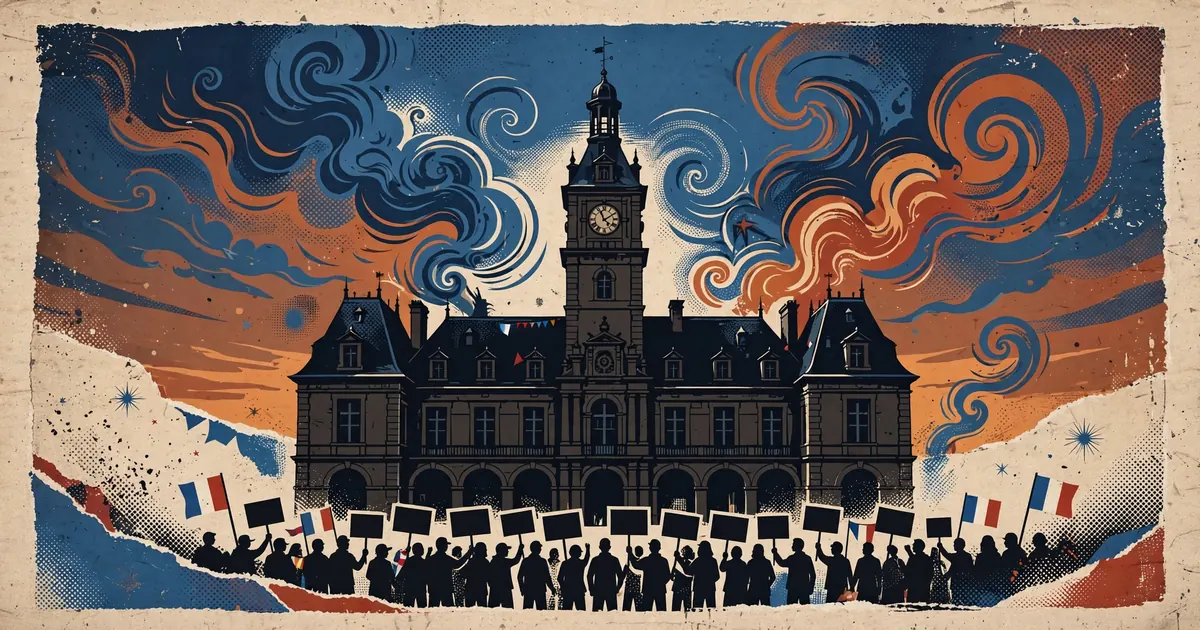
How a school protest became a national revolt
The movement’s roots are unglamorous. In mid-September, pupils at the Saint-Exupéry high school outside Paris walked out over overcrowded classrooms, teacher shortages and overheated buildings. Within days, walkouts had spread to schools nationwide — and the demands had widened.
Protests first organised on social media around fuel prices soon fused with anger over crumbling schools, the rising cost of living and cuts to public services. Unions joined, along with self-described “yellow vests” — veterans of the 2018 movement that rocked Macron’s first presidency. The scale was already alarming: Nuñez told MPs on October 7 that arrests had hit 6,629, and a week later Lecornu told the Senate that 937 police officers and gendarmes, 248 students and 149 education staff had been hurt.
Lecornu himself is a Macron ally who took office in September 2025 after his predecessor lost a confidence vote over budget cuts — the seventh prime minister of Macron’s presidency.
The night France burned: Limoges, Paris, Marseille
The most shocking scene came from Limoges. Shortly after 6 p.m., a masked group set a police car on fire outside the town hall, smashed its windows, broke in and started a fire on the ground floor. Flames raced to the roof; the bell tower collapsed. Regional prefect Maurice Barate told AFP that “the roof has collapsed onto lower floors, except the west wing, and two-thirds of the exterior has already disappeared.”
Barate described the destruction of the 143-year-old building — built in 1883 and listed as a historic monument in 1975 — as a “catastrophe for heritage,” blaming what he called a “deliberate act by hooligans.” Prosecutors opened a criminal investigation, and more than 15 people were detained.
Elsewhere, the night was chaotic. In Paris, masked demonstrators hurled fireworks at riot police near Place de la République, and officers answered with tear gas and water cannons. A car and a newspaper kiosk were set ablaze; protesters built barricades on the Champs-Élysées despite a police ban.
AFP reported dozens of shops looted in Paris, Marseille, Nice, Nantes, Bordeaux, Limoges, Lille, Toulouse and Strasbourg. In Marseille, black-clad protesters forced their way into city hall, smashed furniture and toppled a historic bust of Marianne; a Hermès boutique was vandalised and an Apple store was looted in Lille. In Lyon, hooded individuals set fire to the tourist office on Place Bellecour — Mayor Grégory Doucet called it “a tragedy.” Paris Mayor Emmanuel Grégoire said whole streets of the capital “have been devastated.”
Government responds: blame on the far left
Lecornu condemned the violence in a post on X, saying police and gendarmes had faced “violence of extreme intensity.” He blamed “ultra-left” groups for organising the violence, and issued a pointed warning: “To those who clearly intend for this violence to serve as a ‘warm-up’ ahead of the presidential election, we will not be intimidated.”
He did not name those he was addressing. In a reply to hard-left leader Jean-Luc Mélenchon, Lecornu called blaming police chiefs for the violence a “dangerous and cynical inversion of responsibilities.” He also pointed to a bill due before the Senate this month that would make rioters financially liable for the damage they cause. Interior Minister Nuñez ruled out declaring a state of emergency and promised looters would be tracked down.
President Emmanuel Macron weighed in on social media: “There is no place for violence in our republic.” Those who had “vandalised and attacked” prefectures and businesses and “looted” town halls, he wrote, would be “prosecuted and punished,” adding: “We will all stand united against the sowers of chaos.”
Mélenchon, whose La France Insoumise party backs the student movement, said most demonstrations were peaceful and criticised the police response, while the right and the far-right National Rally backed the police.
Injuries raise questions about policing
The human toll went beyond property damage. In Saint-Étienne, a 17-year-old protester lost his right hand to a grenade; the local prosecutor handed the investigation to the police inspectorate, the IGPN. It was not the first such case: earlier this month, a 15-year-old student in Lens lost a hand in a similar incident.
Nuñez said around 60 law enforcement officers were injured in Saturday’s clashes, including two knocked unconscious; Lecornu later raised the figure to 150 hurt. He has also said 36 investigations into alleged police violence have been opened since the movement began — a secondary battleground in the political fight over Saturday’s events, and one that will matter as Parliament debates the proposed rioter-liability law.
Protests spread beyond France’s borders
The unrest was not contained to France. In Brussels — where students have been demonstrating for weeks against university registration fees — police fired tear gas and water cannon at protesters accused of launching projectiles and setting fires; water cannon was also used in Liège. In Lisbon, tens of thousands marched against the cost of living, low wages and unaffordable housing. Al Jazeera’s roundup also named Italy among the countries seeing cost-of-living protest action — another sign of a strained year for European governments, from Paris to Berlin.
For readers in Pakistan and South Asia, the resonance is familiar: a protest wave that began in classrooms over basic conditions, sparked partly by fuel prices, growing into a national movement — against a backdrop of European political turbulence that leaders from Berlin to Paris are struggling to contain.
What happens next
Several things will now unfold in parallel. Criminal investigations will run their course in Limoges and in the grenade-injury cases. The Senate bill on making rioters pay for damage will test Parliament’s appetite for tougher penalties. Lecornu’s government will have to decide whether the movement peaks with Saturday’s explosion or keeps building.
And the calendar looms over everything: France heads toward a presidential election in roughly six months, with Macron unable to stand again. Whatever began last month as a school walkout has become the defining crisis of the final stretch of his presidency — and the government knows it.
Sources
- CNN, “Buildings torched and over 1,000 detained after half a million protesters sweep France” (Oct 17, 2026) — https://www.cnn.com/2026/10/17/europe/half-million-protesters-sweep-france-in-youth-unrest-latam-intl
- Al Jazeera, “Cost of living protests hit Belgium, Italy, Portugal and France” (Oct 17, 2026) — https://www.aljazeera.com/news/2026/10/17/cost-of-living-protests-hit-belgium-italy-portugal-and-france
- WION, “At least 400 arrested as protests turn violent in France; PM blames far left” (Oct 18, 2026) — https://www.wionews.com/world/france-cost-of-living-protests-400-arrested-violence-1792258829927/amp
- News18, “France Protests Turn Violent: Apple, Louis Vuitton, Hermès Stores Looted Amid Chaos” (Oct 18, 2026) — https://www.news18.com/world/france-protests-turn-violent-apple-louis-vuitton-hermes-stores-looted-amid-chaos-videos-ws-l-10387121.html
- NY Post, “French rioters set fire to historic Limoges Town Hall as far-left demonstrations spiral out of control” (Oct 17, 2026) — https://nypost.com/2026/10/17/world-news/limoges-town-hall-largely-lost-after-far-left-protesters-cast-flames-on-historic-landmark-amid-french-unrest/
Why are people protesting in France?
The protests began in mid-September with school students demonstrating against overcrowded classrooms, teacher shortages and poor school conditions. The movement then widened — protests over fuel prices fused with broader anger about the cost of living, crumbling public services and budget cuts, drawing in unions and activists.
How many people were arrested in the France protests?
Prime Minister Sébastien Lecornu said more than 1,200 people were arrested during the October 17 demonstrations, and that 150 police officers were injured. Earlier in the day, the Interior Ministry had reported around 400 arrests, with the figure rising sharply as evening clashes escalated.
What happened to the Limoges town hall?
Masked protesters set fire to the historic town hall in Limoges on October 17. The building, constructed in 1883 and listed as a historic monument in 1975, was largely destroyed — its roof and bell tower collapsed, and two-thirds of its exterior was lost. Regional prefect Maurice Barate called it a “catastrophe for heritage,” and prosecutors opened a criminal investigation.
When is France’s next presidential election?
France’s next presidential election is expected in roughly six months, in the spring of 2027, as Emmanuel Macron’s term comes to an end. Macron is not eligible to run again — one reason Prime Minister Lecornu framed Saturday’s unrest as a possible “warm-up” for the campaign.