President Zardari has placed Khyber Pakhtunkhwa under emergency rule under Articles 232 and 234, effectively suspending the PTI-led provincial government after the federal cabinet cited worsening militancy and collapsed talks over the ongoing protest march.
Key takeaways
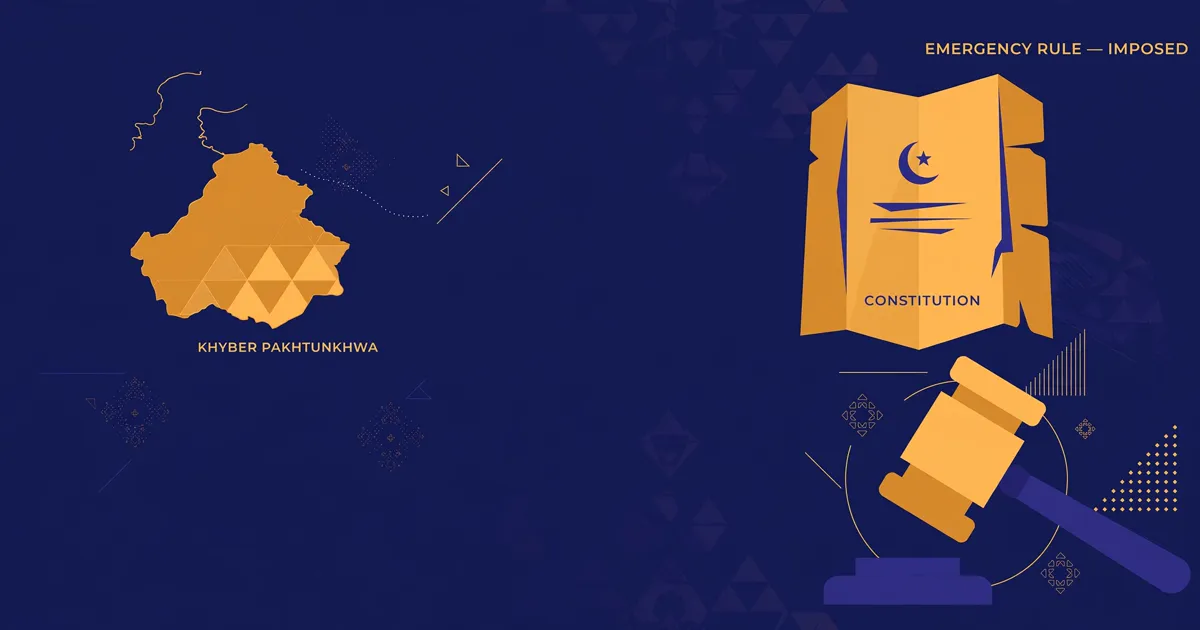
Pakistan placed its northwestern Khyber Pakhtunkhwa province under emergency rule on Sunday, after President Asif Ali Zardari signed a summary imposing the measure under Articles 232 and 234 of the Constitution. The presidency announced the decision following a federal cabinet meeting in Islamabad that cited a deteriorating security situation and the breakdown of talks with the provincial government.
The move, confirmed by the president’s office on Sunday, effectively suspends the provincial government and grants the federal government sweeping administrative powers over the province. Khyber Pakhtunkhwa is governed by the Pakistan Tehreek-e-Insaf (PTI), the party of jailed former prime minister Imran Khan, whose supporters have been marching toward Islamabad to demand his release.
Cabinet cited militancy and failed talks
The federal cabinet, chaired by Prime Minister Shehbaz Sharif, was briefed on the province’s law-and-order and terrorism situation before recommending the emergency. According to the cabinet’s assessment, rising militant violence in the northwest combined with what it described as the provincial government’s deliberate indifference toward counterterrorism efforts left no alternative.
Interior Minister Mohsin Naqvi said the government had exhausted its efforts to reach an understanding with the PTI, telling reporters there was “no room left to avoid the imposition of an emergency in KP.” Information Minister Ataullah Tarar confirmed the cabinet had discussed both emergency and governor’s rule as options, while Minister of State for Interior Tallal Chaudhry said several options were being weighed and accused the PTI of refusing to cooperate with the federal government on counterterrorism.
The emergency was invoked under two constitutional provisions: Article 232, which allows an emergency proclamation when the country faces threats such as internal disturbance, and Article 234, which covers a failure of the constitutional machinery in a province and allows the president to assume the provincial government’s functions.
The march and the mediation
The decision comes against the backdrop of the PTI’s continuing protest march demanding Khan’s release. Thousands of supporters have been marching through the province toward the capital, raising fears of a confrontation with federal authorities. Police guarded barricaded roads in Peshawar on Sunday ahead of expected demonstrations.
Efforts to defuse the standoff continued through the weekend. Jamiat Ulema-i-Islam chief Maulana Fazlur Rehman met both Sharif and Zardari on Saturday to discuss ways to ease tensions, and separately met PTI chairman Barrister Gohar Ali Khan and senior party leader Asad Qaiser to warn them of the government’s possible move if the march continued. A senior JUI-F leader said the party was facilitating dialogue, but that the final decision rested with both sides.
On the ground, preparations reflected the expectation of unrest. The KP police chief issued guidelines to district police officers to prepare for possible violent protests, and deputy commissioners and district police officers across the province were instructed to remain in their districts until further orders. Sessions of the National Assembly and Senate are scheduled for Tuesday, where the emergency proclamation is expected to come under scrutiny.
Why it matters
Emergency rule in a province is one of the most consequential tools in Pakistan’s constitutional arsenal, and it has been used sparingly in recent decades. Suspending an elected provincial government — in this case one controlled by the country’s largest opposition party — is almost certain to deepen the confrontation between the federal government and the PTI rather than end it.
The timing is also significant. The federal government has framed the move as a security response to rising militancy in the northwest, but the province’s elected leadership is being set aside at precisely the moment its party is mobilising on the streets. How the courts, parliament, and the PTI itself respond will determine whether this becomes a short-term intervention or a protracted constitutional crisis.
What’s next
The federal government is expected to formally take over the province’s administration in the coming days, with security forces on heightened alert across KP. The PTI has not yet announced whether it will challenge the proclamation in court, continue its march, or both. Tuesday’s parliamentary sessions should provide the first test of how the ruling coalition plans to justify the decision politically, while the JUI-F’s mediation channel remains the most likely path to a negotiated de-escalation.
Sources
- Reuters — Pakistan president imposes emergency in province ruled by ex-PM Imran Khan’s party (October 11, 2026)
- Arab News / AFP — Pakistan imposes emergency rule in northern province after protests: presidency (October 11, 2026)
- Gulf Today / AFP — Pakistan imposes emergency rule in northern province after protests (October 11, 2026)
- The Business Standard (UNB) — Pakistan government weighs emergency rule in KP amid widening rift with PTI (October 11, 2026)