Key takeaways
Canada and the EU launched an Alliance for the Future at their Montreal summit, concluding digital trade and competition deals and opening talks on closer association by 2027. Canada also pledged an initial 500 million euros to the EU’s Ukraine support loan. The ‘associate member’ label remains contested and does not appear in the joint statement.
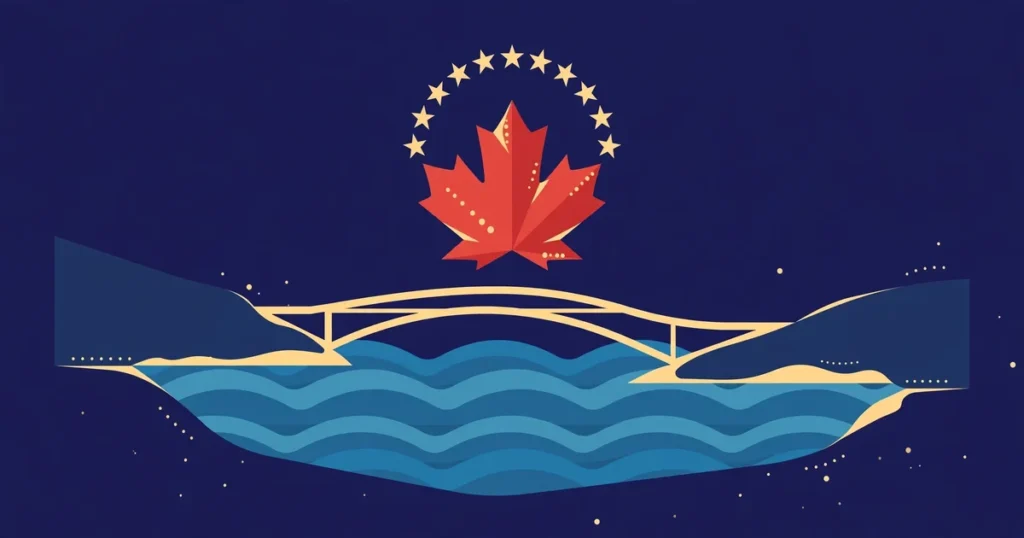
Canada and the European Union have launched what they call an Alliance for the Future, a sweeping partnership covering trade, technology, critical minerals, security and student exchanges, after a two-day summit in Montreal. The joint statement, issued on 30 October at the close of the 21st Canada-EU summit, frames the pact as an effort to build a common prosperity and economic security space at a time of geopolitical tension and economic fragmentation.
Canadian Prime Minister Mark Carney hosted the summit alongside European Commission President Ursula von der Leyen and European Council President Antonio Costa. The leaders said the alliance would be based on reciprocity in industrial sectors where both sides agree to deepen cooperation, with the aim of building more integrated and resilient supply chains across their markets.
What was actually agreed
The most concrete outcomes are three deals whose substantive negotiations are now concluded. The first is a Digital Trade Agreement designed to complement the existing Canada-EU trade deal, known as CETA, by setting a modern framework for digital trade, improving legal certainty, easing cross-border data flows and building confidence in the digital economy for businesses and consumers. The second is a second-generation Competition Agreement to strengthen cooperation between competition authorities against anti-competitive conduct. The third is an agreement for the European Investment Bank to facilitate European investment in critical Canadian resources, particularly critical raw materials.
Beyond those three, the statement lists a series of further steps: Canada will join the European High-Performance Computing Joint Undertaking, linking its supercomputing resources with Europe’s; the two sides agreed on a Frontex-Canada Border Services Agency working arrangement on border cooperation; and they will open new dialogues on the Arctic, foreign information manipulation, climate security and transport. On space, they will launch negotiations toward Canadian access to Galileo, the EU’s satellite navigation system, and exploratory talks on cooperation with IRIS2, the EU’s planned secure communications constellation. On energy, they will carry out a joint long-term feasibility study on liquefied natural gas exports to Europe.
For ordinary citizens, the most tangible promise may be on education. The two sides will launch negotiations toward deeper Canadian participation in Erasmus+, the EU’s flagship student exchange programme, and will explore a next-generation youth mobility partnership. They will also work toward Canada’s participation in future European research programmes, including Horizon Europe.
The ‘associate member’ question
The headline that travelled furthest before the summit, the idea of Canada becoming the EU’s first “associate member”, is precisely the part the final statement does not settle. Carney has described the goal in those terms, telling reporters: “We are working towards the deepest possible partnership, short of accession.” But the joint statement itself uses different language, committing the two sides to define, by the 2027 EU-Canada summit, the concept of “an ever-closer association of Canada to the EU, short of full membership itself”.
That gap matters. Reuters reports that the “associate member” term has no legal meaning and is opposed by Germany and several other EU countries, which is why it does not appear in the final text. Readers should therefore treat “associate member” as a political ambition voiced by Ottawa, not as a status Canada has gained. What has been agreed is a process: a year of work toward defining what an ever-closer association would actually contain, with the next summit as the deadline.
The distinction is worth keeping in mind for every other claim in the statement, too. Concluding negotiations on a digital trade deal is not the same as that deal taking effect, and no date for it to enter into force was given. Likewise, opening talks on Galileo access or Erasmus+ participation is a starting point, not a completed arrangement.
Ukraine: 500 million euros, and a much larger gap
Ukraine was a central item on the summit agenda. Canada announced its intention to join the EU’s Ukraine Support Loan, with an initial contribution of 500 million euros. The loan mechanism totals 90 billion euros, and according to a Canadian government backgrounder cited by the Kyiv Independent, Canada’s participation would also allow Ukraine to buy military equipment from Canadian defence companies using EU funds.
The contribution arrives against a large funding gap. Kyiv expects a shortfall of at least 70 billion euros next year, even after accounting for 45 billion euros the EU is already set to disburse, the Kyiv Independent reports. Canada’s initial pledge is therefore best read as an opening contribution, and Ottawa has signalled further direct financial support may follow. The EU itself is still discussing additional support on top of the 45 billion euros, with hopes that an announcement will come by the end of the year.
The summit statement reaffirmed continued support for Ukraine’s independence, sovereignty and territorial integrity within its internationally recognised borders, and for a comprehensive, just and lasting peace based on international law. It also pledged further pressure on Russia and accountability for crimes committed in and against Ukraine.
Why it matters
The deeper significance of the Montreal summit lies in its timing. The summit unfolded against a backdrop of trade tension with Washington, which Al Jazeera notes has pushed traditional United States allies to deepen ties elsewhere. Canada and the EU already trade under CETA, in force since 2017, but the new alliance extends that relationship into areas where dependence on a single supplier or market has become a strategic risk: critical minerals, semiconductors, energy, vaccines, payment systems, space communications and artificial intelligence.
The joint statement makes that logic explicit, arguing that sovereignty now requires secure access to those goods and capabilities rather than simply the ability to feed, fuel and defend a country. That is why the same document moves from trade to defence, with the two sides pledging to accelerate their Security and Defence Partnership, complementing NATO, and to cooperate on cyber security, maritime security and wildfire management. Canada’s participation in the EU’s Security Action for Europe instrument, agreed earlier, forms part of the same shift.
For businesses, the practical test will be whether the promised machinery works: sectoral road maps under an industrial policy dialogue, a new business council, closer regulatory cooperation, and work toward connecting instant payment systems for faster and cheaper cross-border transactions. For students and researchers, the test will be whether Erasmus+ and Horizon Europe participation turns into real places and funding. For Ukraine, the test is simpler and more urgent: whether the money arrives in time to close next year’s budget gap.
What’s next
Three dates and decisions will show whether the Alliance for the Future becomes more than a statement. First, the 2027 Canada-EU summit, by which the two sides must define the ever-closer association, including whether the contested “associate member” label survives in any form. Second, the entry into force of the digital trade and competition agreements, which still require their own legal and ratification steps. Third, the EU’s decision on further Ukraine funding by the end of the year, and whether Canada adds to its initial 500 million euros.
Until those steps land, the honest summary is this: Canada and the EU have agreed on a direction, concluded three negotiations, and set a deadline for defining a closer relationship. As the joint statement puts it: “We are stronger together.” Whether that proves true will be decided by what follows the summit, not by the summit itself.
- Istanbul Hosts First R4+E3 Foreign Ministers’ Meeting on Hormuz Shipping Security
- Lagarde to Step Down as ECB President on 7 February 2027
- Vance Writes to Iran’s Security Chief in Last-Ditch Bid to Revive Peace Talks
Sources
- Government of Canada, Prime Minister’s Office: Joint Statement, Canada and the European Union building together an Alliance for the Future, 30 October 2026. https://www.pm.gc.ca/en/news/statements/2026/10/30/joint-statement-canada-and-european-union-building-together-alliance
- European Council (Consilium): EU-Canada summit, 29-30 October 2026, main results. https://www.consilium.europa.eu/en/meetings/international-summit/2026/10/29-30/
- Reuters: EU, Canada to define “ever-closer association” by 2027 summit, 30 October 2026. https://www.reuters.com/world/eu-canada-define-ever-closer-association-by-2027-summit-2026-10-30/
- Al Jazeera: EU and Canada seek deeper ties amid worsening global uncertainty, 30 October 2026. https://www.aljazeera.com/news/2026/10/30/eu-and-canada-seek-deeper-ties-amid-worsening-global-uncertainty
- Kyiv Independent: Canada pledges 500 million euros toward Ukraine support loan amid 2027 budget shortfall, 31 October 2026. https://kyivindependent.com/canada-pledges-500-million-euros-toward-ukraine-support-loan-amid-2027-budget-shortfall/