Key takeaways: Iranian negotiators spent a third straight day in Doha talking through Qatari mediators about a plan to reopen the Strait of Hormuz, as the United States heads into midterm elections on November 3. Washington says no decision has been made on new strikes, while Gulf states warn that another round of fighting would help no one.
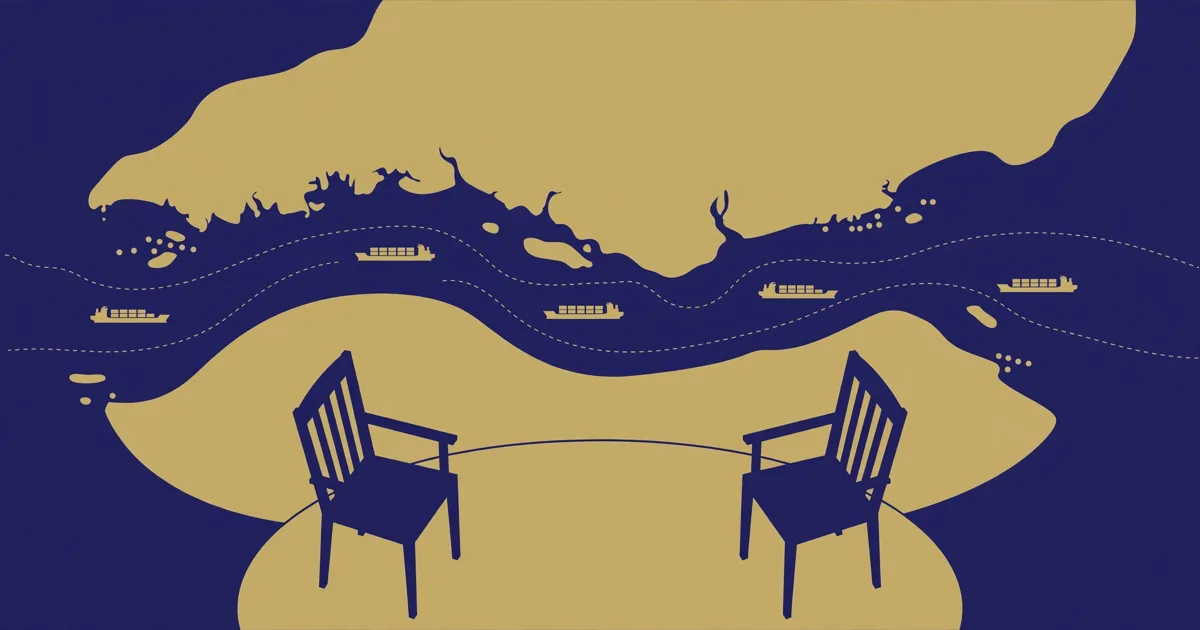
Iranian negotiators were in Doha on Sunday for a third consecutive day of talks with Qatari mediators, in a last diplomatic push to end the war between the United States, Israel and Iran before the political calendar in Washington changes the equation.
The discussions, reported by Reuters citing an official briefed on the talks, centre on a proposal that could reopen the Strait of Hormuz, the narrow waterway through which a large share of the world’s seaborne oil moves. Iranian Foreign Minister Abbas Araghchi has said the strait could reopen within two days if Washington meets a set of Iranian conditions, though no final agreement has been announced.
The timing is what gives the talks their urgency. The United States holds midterm elections on Tuesday, November 3, and President Donald Trump has said the US will not launch new attacks on Iran before the vote, while leaving open the possibility of military action afterwards. That pledge has turned the days around the election into both a deadline for diplomacy and a window of danger.
What is on the table in Doha
Qatari mediators travelled to Tehran on Friday before the talks moved to Doha on Saturday, according to Reuters. The channel is indirect: Araghchi has said there are no direct talks under way with the United States.
Araghchi set out Tehran’s conditions in comments to Al Jazeera. They include the lifting of recently imposed US sanctions, the reinstatement of oil waivers granted in June, a reduction in the US military presence in the region, recognition of new shipping routes in the Strait of Hormuz designated by Iran and Oman, and an end to the conflict on all fronts, including Israeli attacks on Lebanon.
Qatari and Pakistani mediators were “continuing consultations regarding our conditions,” Araghchi said. Pakistan has played a visible mediation role in the crisis: its army chief, Field Marshal Asim Munir, has visited Tehran several times as part of the diplomatic effort, and Doha and Islamabad both played key roles in the June memorandum of understanding that collapsed in August.
Iran’s security chief, Mohsen Rezaei, told Al Jazeera that the US had “indicated its readiness” to accept Tehran’s conditions, though Washington has not confirmed that claim.
Washington: diplomacy preferred, strikes undecided
US Secretary of State Marco Rubio said on Saturday, October 31, that Trump had not decided whether to launch new strikes on Iran, but would prefer a diplomatic solution. Speaking at a press conference in Atlanta, where he was hosting G20 foreign ministers, Rubio said: “We can achieve military objectives if we seek to.” He added that he had “no announcement” on further military action, and declined to characterise the progress or timeframe of the talks.
Trump himself has sent mixed signals. On Saturday he described the negotiations as “going fine” but “not very reliable,” and said the US still had several Iranian targets to “take care of,” singling out a suspected underground nuclear complex known as Pickaxe Mountain. He said the US could deal with “one or two sites” in 10 minutes and achieve its military objectives “very quickly,” while adding that he was not in a hurry.
At a campaign rally in Dubuque, Iowa, on Sunday, Trump renewed the warning in blunter language, saying the US may eventually have to “give them the hammer,” while noting he had held back from further attacks to avoid additional casualties.
Earlier in the week, US Vice President JD Vance wrote to Rezaei, reportedly to gauge the prospects of restarting negotiations. Rezaei said the letter’s tone had “completely changed” from earlier correspondence, and Araghchi called the attempt to open dialogue a “positive step.”
Tehran: ready to talk, braced for war
Iran’s leadership has paired its openness to talks with stark warnings about what renewed fighting would bring. Supreme Leader Ayatollah Mojtaba Khamenei issued a statement on Saturday ordering the armed forces to be prepared to respond to any attacks, and warning that any Iranian response would be “immediate” and “without geographical limitations.” He also ordered commanders to update Iran’s target list to include what he called all types of tangible and intangible assets of the American and Israeli enemy.
Araghchi said Iran’s armed forces were “more prepared for war than any time before” and ready for any scenario. Rezaei warned that Iran would use “new weaponry” in response to any future attack. Iran insists its nuclear programme is for civilian purposes; Trump has repeatedly said Iran must never be allowed to acquire a nuclear weapon.
Tehran has repeatedly warned that it would respond to any new attacks by striking US and Israeli targets in neighbouring countries, the central fear for Gulf states, which bore Iranian missile and drone attacks after the war began on February 28 with joint US and Israeli strikes on Iran, followed by Iranian attacks on Gulf nations.
The Gulf states: urging a breakthrough, bracing for the worst
The United Arab Emirates’ presidential adviser, Anwar Gargash, told the Manama Dialogue security forum in Bahrain on Sunday that his country hopes a diplomatic breakthrough in Qatar-led mediation is possible to avert a new round of confrontation. “We don’t really want to see another round of confrontation in the region,” he said, adding that military solutions “will only complicate the current very complicated scene” and “will not actually bring any quick off-ramps.”
Gargash also warned that the US and Iran remain far apart. “If these positions are not bridged, then we have to worry about the worst,” he said, according to the Associated Press.
Israel adds another layer of pressure. Prime Minister Benjamin Netanyahu has reportedly urged Trump to launch fresh strikes immediately after the midterm elections, according to an Axios report cited by News18, following a phone conversation between the two leaders on Saturday. Trump confirmed on Sunday that he had spoken to Netanyahu but did not disclose details of the discussion. Separately, the Wall Street Journal has reported that Washington warned Gulf allies to prepare for a short, intense campaign that could begin as early as November 4, the day after the vote.
Netanyahu has said Israel has a “historic, one-time opportunity” to remove the Iranian threat once and for all.
Why it matters: oil, shipping and the wider region
Brent crude futures fell $1.51, or 1.33 percent, to $111.92 a barrel in early Asian trade on Monday, while US West Texas Intermediate crude was at $102.34, down 1.71 percent, after the third day of talks was reported. Brent had touched a six-month high of $118 on Friday. Qatar’s benchmark stock index rose 4.6 percent on Sunday, its sharpest intraday gain in more than eight years.
Those swings matter well beyond trading screens. The Strait of Hormuz is a chokepoint for global energy supplies, and eight months of war have already disrupted oil flows across the Middle East. A deal that reopened the strait would ease pressure on energy prices and shipping; a new round of strikes and retaliation would risk wider disruption and higher prices.
Andreas Krieg, an associate professor of security studies at King’s College London, told Al Jazeera the November 3 elections give Iran an incentive to delay concessions to deny Trump a diplomatic victory, but that calculus could change afterwards, when Trump faces fewer domestic restraints on military action. “We could therefore reach a situation where Iran becomes more willing to compromise precisely when Washington becomes more willing to strike,” Krieg said.
What happens next
Three dates now frame the story. First, the Doha talks themselves: whether the third day of discussions produces a concrete proposal, and whether Washington answers Tehran’s conditions, will be the first signal of whether mediation is advancing or stalling. Second, November 3, the midterm elections, after which Trump’s self-imposed pause on new strikes expires. Third, November 4, the earliest date Gulf officials have reportedly been warned to prepare for, if diplomacy fails.
None of those dates guarantees an outcome: Trump has not decided on strikes, according to his own secretary of state, and Iran has not agreed to anything in writing. But the window between the Doha talks and the US vote is now very short, and the next move, whether a signed understanding or a new round of fighting, is likely to come within days, not weeks.
For Pakistan, the stakes are direct as well as diplomatic: as a mediator, Islamabad holds a rare seat at the table, and as a neighbour of Iran and an energy importer, it would feel both the relief of a Hormuz reopening and the shock of a wider war.
Sources
- Reuters, “Iranian negotiators in Doha to continue talks to end the US-Iran war, official says,” November 1, 2026: https://www.reuters.com/world/middle-east/iranian-negotiators-doha-continue-talks-end-us-iran-war-official-says-2026-11-01/
- Reuters, “Oil slips more than 1% as talks continue on ending Iran war,” November 1, 2026: https://www.reuters.com/business/energy/oil-slips-more-than-1-talks-continue-ending-iran-war-2026-11-01/
- Al Jazeera, “Mediators continue US-Iran negotiations amid war rhetoric: What we know,” November 1, 2026: https://www.aljazeera.com/amp/news/2026/11/1/mediators-continue-us-iran-negotiations-amid-war-rhetoric-what-we-know
- The Hindu, “Rubio says U.S. yet to decide on new Iran strikes,” November 1, 2026: https://www.thehindu.com/news/international/rubio-says-us-yet-to-decide-on-new-iran-strikes/article71651951.ece
- Associated Press via Military.com, “United Arab Emirates Says Military Solutions Offer No Quick Off-Ramps to Crisis With Iran,” November 1, 2026: https://www.military.com/united-arab-emirates-says-military-solutions-offer-no-quick-off-ramps-to-crisis-with-iran
- News18, “Netanyahu Presses Trump For Iran Strikes After US Midterms, Tehran Warns Of Longer War,” November 2, 2026: https://www.news18.com/world/netanyahu-presses-trump-for-iran-strikes-after-us-midterm-elections-2026-middle-east-conflict-us-israel-iran-war-ws-l-10408050.html
- Khaama Press, “Trump Renews Threat to Strike Iran: US ‘Give Them the Hammer’,” November 2, 2026: https://www.khaama.com/trump-renews-threat-military-strikes-iran/