Key takeaways
Brazilians vote today, October 4, in the first round of the 2026 presidential election. Polls show 80-year-old incumbent Luiz Inácio Lula da Silva narrowly ahead of Senator Flávio Bolsonaro, the jailed former president’s son. If no candidate wins more than 50% of valid votes, the race heads to a runoff on October 25.
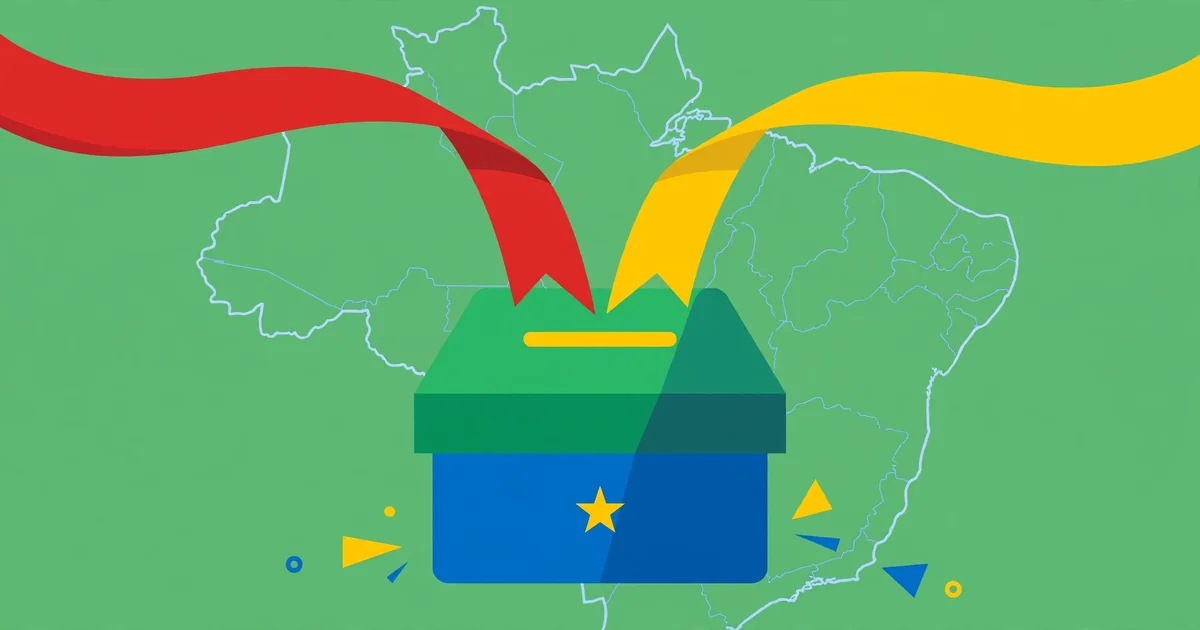 Illustration: WHAT TODAY?
More than 150 million Brazilians are eligible to vote on Sunday in the first round of a presidential election the rest of the world is watching almost as closely as Brazil itself. Incumbent President Luiz Inácio Lula da Silva is seeking a fourth, nonconsecutive term, while his main challenger is Senator Flávio Bolsonaro — the eldest son of former president Jair Bolsonaro, who is serving a 27-year prison sentence for plotting a coup to overturn his 2022 defeat to Lula.
The final polls point to a runoff
A flurry of polls published on Saturday put Lula slightly ahead in the first round, but none gave him a first-round knockout. The CNT/MDA survey had Lula at 47.8% of valid votes against 42.1% for Flávio Bolsonaro; Datafolha put the gap at 45% to 42%; and Quaest showed the tightest race of all, 46% to 45%. An earlier AtlasIntel survey for Bloomberg put it at 45% to 42%.
Under Brazil’s rules, blank and null ballots don’t count — so if no candidate clears 50% of valid votes today, the top two advance to a runoff on October 25. On that front, the pollsters agree the second round would be a dead heat: Datafolha projected Lula at 47% to Bolsonaro’s 46%, Quaest had Bolsonaro at 44% to Lula’s 42%, and AtlasIntel found them effectively tied at 47.7% to 47.6%. A thin band of undecided voters, plus abstention, could decide it.
A rematch with a twist
This is a rematch of Brazil’s bitter 2022 contest — with one major change. The man Lula narrowly defeated four years ago is behind bars, sentenced to 27 years for attempting a coup after that loss, so the Bolsonaro movement is now carried by his 45-year-old son. Flávio Bolsonaro has promised to pardon his father if elected, and observers say a win would likely mean the elder Bolsonaro’s release.
The younger Bolsonaro describes himself as “a more moderate Bolsonaro,” but has shown few major policy differences with his father: he has cast doubt on humans’ responsibility for climate change and supports making it easier for Brazilians to buy guns. Lula, meanwhile, has framed the vote in stark terms, telling supporters in São Paulo that “on one side, we have democracy and sovereignty; on the other, barbarism and corruption,” in remarks carried by the Associated Press.
Why the world is watching
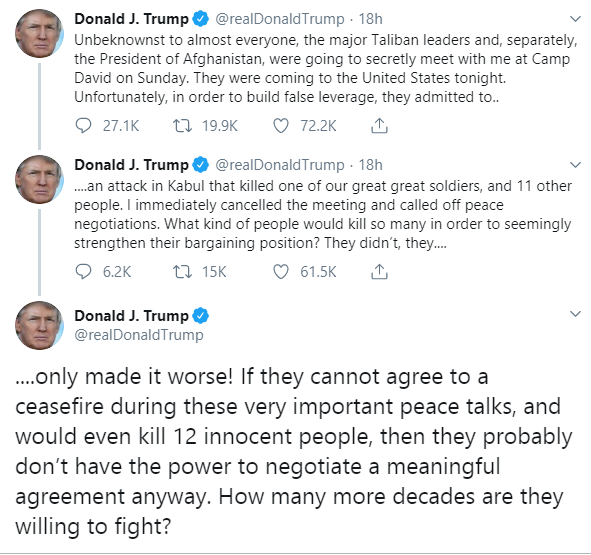
Few elections this year carry this much global weight. Washington is a central character in the campaign: last year, US President Donald Trump imposed a 50% tariff on Brazilian imports over the trial of Jair Bolsonaro, which Trump called a “witch hunt.” Lula has accused Trump of trying to sway the election to capture Brazil’s natural resources, while Flávio Bolsonaro has positioned himself as the pro-America candidate, pledging to counter China and deepen ties with the United States.
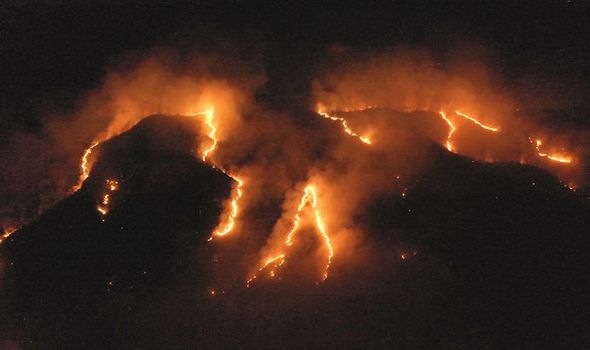
The next president will also nominate four of the eleven justices on Brazil’s Supreme Court — the same court that convicted the former president — giving the winner influence over the judiciary for years. And the outcome could reshape the future of the Amazon: Brazil contains about 60% of the world’s largest rainforest, deforestation surged by roughly 60% during the elder Bolsonaro’s presidency, and fell by 45% under Lula to its lowest level in more than a decade. Flávio Bolsonaro has pledged to end illegal deforestation by 2029; Lula’s target is zero net deforestation by 2030.
The final day on the trail
Both frontrunners spent Saturday campaigning in São Paulo state, which holds a fifth of the country’s votes — some 34 million eligible voters in a state of 46 million people. Lula held his traditional pre-election parade on Paulista Avenue; Flávio Bolsonaro toured countryside cities. The one televised debate that would have featured both men, scheduled for Thursday on TV Globo, was cancelled after both candidates stayed away.
Brazil votes on electronic ballot boxes, so preliminary results should be available within hours of polls closing on Sunday evening — meaning the first-round picture will be clear tonight, local time. Sunday’s ballot also decides more than a thousand congressional, gubernatorial and regional seats, but the presidency is the contest everyone is watching.
What happens next
If today’s vote produces no outright winner — as every final poll suggests — the campaign compresses into three weeks of runoff sprinting before October 25. Endorsements from the eliminated candidates, above all whoever finishes third, will be the first prizes of the night. A Lula win keeps Latin America’s largest democracy on its current left-leaning course; a Flávio Bolsonaro win would return the Bolsonaro movement to power, likely free the jailed former president, and rewire Brazil’s relationships with Washington and the world.
This is a developing story. Results will be added as they come in.
Sources
- “Lula ahead in polls for Brazil’s first-round vote; runoff likely” — Reuters (via The Hindu), Oct 4, 2026
- “Brazil’s Lula and Flávio Bolsonaro campaign in powerhouse state ahead of Sunday’s presidential vote” — Associated Press, Oct 3, 2026
- “Brazil’s big political rematch: What to know about the Brazilian election” — NPR, Oct 3, 2026
- “Lula da Silva or Flavio Bolsonaro? What latest poll says about Brazil’s presidential race” — Bloomberg/AtlasIntel (via Hindustan Times), Oct 2026
- “Future of Amazon rainforest policies at stake in Brazil’s presidential election” — Associated Press (via New Indian Express), Oct 2, 2026
- “Brazil votes with Lula and Flávio Bolsonaro tied and a small group of undecided voters holding the key” — MercoPress, Oct 3, 2026